maja

cws: light torture (not in too much detail), blood
n.b. this did NOT happen in the campaign. [jonathan frakes voice] i made it up. but like. it totally could have happened, y'know?
Ansel didn't quite seem to understand the gravity of the situation that was currently at hand. Though, whether that was out of ignorance of what was going on or damn sheer stubbornness remained to be seen. Or, there was the secret third option, that he was simply lying about his reaction to everything that was going on right now, as Ansel was wont to do.
Nevertheless, the situation at hand certainly HAD hands, as it were. Specifically, hands that may as well have been disembodied for all Ansel could see of their owners, that were currently intermittently raining blows on his face, bloodying his nose badly, nearly ripping out his septum piercing, and attempting to pulverize the rest of his facial features.
Ansel attempts to no-sell it, but ignoring the fact that your face is getting beaten in isn't easy, and he hisses as another punch lands. “Fuck!” he spits, literally and figuratively, as blood and spittle flies from his mouth along with the curse. But then, his face returns to a placid, smug, almost taunting neutrality, which seems to anger his captors further.
“Once more, with feeling, kid. Who are you? Who are your teammates? And, most importantly: Who are The Roots?”
---
The gravity had been literal at first, or rather, the lack thereof; it had been their first mission in zero-g, in the space around Sparrow, with the goal to destroy one of the space elevators that the AAL would use to descend onto the planet. The AAL, or Alternate Advanced Labs, had more or less colonized the planet of Sparrow, giving them a devil's bargain of advanced tech and a helping hand into the rest of the universe in exchange for their labor, their land, and the introduction of a ‘debt system' that kept most of the citizens of Sparrow in poverty, even more so when the concept of ‘family debt inheritance' was introduced.
Thus, up sprang the Roots, a relatively small resistance group that had, thus far, done a pretty good job of doing what they set out to do. Though they'd struggled at first, once they were able to break the AAL-imposed information barrier and manufacture and print their own weapons, up to and including mechs.
Ansel (— or rather, Damocles, as he was known in the cockpit) and his teammates, Casey and Mina (Bulwark and Kestrel respectively in the cockpit), were part of the Roots, and were often its hand to go and Get Shit Done, as it were. So far, under the banner of the Roots, they'd done many things, intercepting AAL cargo, rescuing hostages, even preventing an NHP from cascading (any more than it already had, at any rate. Never mind that the fact that the NHP cascading was kiiiiind of Ansel's fault to begin with). And, of course, many, many mech fights.
This mech fight, despite being in low / zero gravity, was presented as any other as the three pilots had climbed into their mechs, load-outs of said mechs rearranged to accommodate them in the differing environment.
Their preparations… were not enough. Despite normally holding their own in fights, even dominating their enemies at times, this time the AAL's superior firepower and sheer amount of money they had to throw at their problems won out. The fact that the trio had never fought in zero-g before probably did not help. Kestrel's mech was completely destroyed, leaving Bulwark to scoop her out of space and into her own mech, but Ansel “Damocles” Goodenough did not fare quite so well.
His normal choice of frame, the Horus Goblin, a small, fragile, hacking-oriented mech, was probably not the best choice here, but Ansel was a creature of habit, and even with some tweaks to suit space-based fighting, he still found himself captured by their opponents, literally swallowed whole by an enemy mech. Not much he could have done there beyond picking a different frame, but he was stubborn above all (other than, perhaps being a liar).
---
And so, that's how Ansel found himself tied to a shitty wooden chair in a dimly lit, windowless room, facing interrogation by nameless AAL mooks. The single light in the room, an overhead light whose bulb probably hadn't been changed in years, illuminated little but cast many more shadows. Ansel could not see the face of any of his captors, which is probably just how they liked it.
Ansel does not deign to answer the questions that the man had posed to him; instead, his forked tongue (literally, in this case; Ansel loved body mods) darts out from his mouth and licks some of the blood that was flowing from his nose and other various cuts and scrapes. He smirks with widened eyes, though the cockiness could be natural, or it could be from the adrenaline and blood loss. “Roots are from like, trees and plants and shit. Are you stupid?”
The man's response is to immediately swing a right hook into Ansel's face again (once more with feeling, you could say), causing his head to whip to the side, but the man moves quickly, grabbing a fistful of the curly blond hair and jerking it so that Ansel is face to face with him, and his anger is palpable. “Listen, you little shit, you think you're so funny? I'm about to be hilarious.”
Ansel's eyes are glazed over slightly, the blow to the head dazing him, and he looks through the man instead of meeting his eyes. Though, Ansel can see him now, as blurred as he looks, and what he looks like is any other wageslave bastard working for the AAL: stubble (presumably from staying all night to torture Ansel), a completely average face and body, and some blood spatter on his face and shirt from some of the god only knows how many times he'd hit the kid in front of him.
“If you don't tell us your contacts, and everything you know about the Roots, now, kid, we are going to beat it out of you, and you won't leave this fuckin' room alive!”
Maybe now it's starting to dawn on Ansel the severity of the situation, because Ansel, along with being a good liar, is also skilled at telling when others are lying, and this guy isn't bluffing; should Ansel not tell them what they want to know, they do not intend to let him leave while being among the living still. And while Ansel was fond of bondage, snuff kink wasn't exactly his cup of tea.
Ansel coughs a bit in the guy's face, small droplets of blood splattering his visage further. “Oh-ghhk-okay… okay… I have… something… to tell you,” Ansel forces out at last, and it's the lead guy's turn to grin.
“Good. Makes things easier that way.” He lets go of Ansel's hair, causing his head to lull forward, and slowly, Ansel raises his head once more to lock eyes with the guy who'd spent the last several hours beating the shit and nearly the life out of him.
“The sword of Damocles falls, idiot.”
At that exact moment, the door to the room is absolutely obliterated by an explosion, taking out a couple of the people furthest back from the two of them, and hitting several more with shrapnel. There's a huge, bloody smirk on Ansel's face now, and the man who just got owned by facts and logic hastily turns to face the ex-door-now-hole-in-the-wall, which is belching smoke.
In the smoke, two distinct silhouettes are visible; one is tall and burly, the other smaller and more wiry, but both very blatantly armed to the teeth, even aside from the explosives they'd used to gain entry to the shoddy torture chamber.
The taller one immediately charges forward, grabbing one person in the small group by the throat and heaving them into another one, sending both people crumpling to the ground. The smaller one, on the other hand, promptly seems to disappear into the smoke, waiting for a chance to strike.
Casey knocks a couple of heads together (literally, causing the bodies to collapse to the floor), before staring down the man who'd done the vast majority of the harm to Ansel. The wageslave, being average in height and weight, is also average in courage; he cowers from her, but instead of any feats of strength, she merely punches him square in the nose, knocking him unconscious.
With most of the room taken care of by Casey, Mina slips back into existence from wherever she was hiding, right behind Ansel, and pulls out a combat knife and sets to cutting his binds.
Once the last rope is cut, Ansel goes to stand up, takes one step forward, and his legs proceed to immediately give out from under him, sending him to the floor with a mumbled, “Fuck!” But Mina and Casey both are there for him, pulling him back to his feet. He leans on Mina for now, arm around her neck to keep himself upright.
“We don't have much time,” Casey warns, as Mina retrieves a pistol from her gear and hands it to Ansel. “Think you can aim?”
Ansel nearly drops the pistol at first, but then his grip steadies. His face and chest are soaked with blood, and his blue eyes are wide. “I can do anything,” he declares, delirious with blood loss.
“That's good,” Mina says, as an alarm starts to blare in the building, presumably from where they'd blown a hole in the wall and also infiltrated an AAL building.
‘INTRUDER ALERT' the security system cries, and all three of them know they'll have to fight like hell to get out of there. But they had to fight like hell to get in here, and they're not about to leave anyone behind now.
The trio shares a look, Casey and Mina lingering on Ansel for just a moment longer to make sure he's not about to fall over again, and then Ansel takes a step forward, toward the door or what was left of it, gun raise, ready to fire at will.
“Let's… get the fuck out of here,” he says, “Let's go home.”
---
It took a long time for them to get home, and they didn't make it out unscathed, but in the end, they make it home nonetheless.
All three of them need to be seen by medics when they get in, Ansel especially, and after that is the debriefing. After all, don't want to face the brass covered in blood. And sure, it could have gone better, but it could have gone a lot worse, the mantra of several of their missions so far.
After that, they part ways; Casey and Mina both return to their homes outside the Roots' headquarters (Mina has a hot date; Casey simply wants to go to work the next morning, with a union meeting after), and Ansel, with no where else to go, his primary place to live being in the HQ, returns to his room.
Waiting there for him is the NHP he'd cobbled together, Dotcom, nicknamed “Dottie”, in her casket in the shape of a pigeon; waiting also is an actual pigeon, his pet carrier pigeon named Emily.
Ansel flops onto his bed and immediately regrets it; he's got a few cracked ribs and one broken one, he should be more careful. And yet, he likely won't. Not his style. As soon as he lies down though, Emily flies over to him, perching on his chest, causing a slight wince, but he doesn't make her move. Dottie also flies over, and tucks herself beside him, between his arm and his chest. Emily coos, almost like a cat purring, and a surprisingly tender expression graces Ansel's face, a gentle smile. Sure, the moment Tex, or Verse, or Tracey, or whoever else knocks on his door or otherwise barges in, it'll be gone, but it's here for now and that's what matters, maybe.
Eventually, Ansel drifts off to sleep, his pigeon and the pigeon-esque NHP casket beside him, and while all is not right with Sparrow, not even close right now, he's filled with the warm thought that maybe one day, it will be.
It's been one job change and platform migration later, but marine science and Mondays wait for no man. So I'm pleased to present a much-delayed new installment in this erstwhile series for the Auldnoir zine.
Today's topic: Phytoplankton blooms!
In my first food web post for MSM, I talked about how surface photosynthesis feeds the entire ocean. In this post, I'm going to go into more detail about food availability, and how plankton populations drive patterns in feeding behavior.
As with a lot of aspects of ocean ecology, the food web is affected by the sheer size and scope of the ocean. In addition to the thousands of meters of depth, there's also a staggering quantity of horizontal space, which add up to volumes and volumes of empty water with nothing else going on. When my biological oceanography professor gave us the food web lecture, he used this Ted Talk as an example.[1]
The metaphor of a single bucket of popcorn scattered throughout an entire theater has stuck with me since then. Therein lies the central problem of living in oceans - how the fuck do you even find your food to begin with?
If phytoplankton are the base of the oceanic food web, then it makes sense that to find your food, you have to go where the phytoplankton are. Either because you're eating them directly, or because you eat the things that will be eating them, and they'll want to be where their buffet's at. For some parts of the ocean, as long as the seasons are right you're good to go. Unfortunately, while the ocean's surface receives plenty of sunlight, not every patch of ocean is created equal when it comes to phytoplankton grazing grounds. Photosynthesis requires CO2 and water, but it also requires other nutrients that are a bit harder to find in the ocean.
Phosphorus, nitrogen, and certain trace metals like iron are all necessary components for phytoplankton (and plants) to do their thing. Macronutrients like nitrogen and phosphate can be regenerated through decomposing organic matter or acquired from the atmosphere via the nitrogen cycle. Micronutrients like iron, however, are largely restricted to terrestrial sources - dissolved into runoff by rain, or eroded into dust and carried by wind.[2] Ergo, the water bodies closer to shore (estuaries, coral reefs, kelp forests) are less nutrient-restricted, while large parts of the open ocean can be nutrient-depleted, or full of untapped nutrient reservoirs because it's missing the iron necessary for plankton to start photosynthesizing any of it.[3] Areas that are high in macronutrients but lack photosynthesis are known as "high nutrient low chlorophyll" (HNLC) waters, and those zones collectively make about 20% of the global oceans.
This is part of why food distribution in the ocean is so patchy. Even within the photic zone slice where light is available, there can be large stretches of space where the conditions still aren't suited. However, these conditions aren't completely static. A sudden burst of upwelling, a stray blast of nutrients from a coastline, and for a brief moment everything is in perfect alignment. And that's when the phytoplankton really go to town.
Plankton blooms are one of the big ways the ocean gets fed. When a nutrient influx or some other environmental condition makes it way easier for phytoplankton to photosynthesize, their populations explode, creating masses so big they color the water and can potentially be visible from space. Scientists can sometimes track blooms via clues from satellite imagery, looking for things like a sudden cold water temperature anomaly at the ocean's surface - a telltale sign of upwelling - followed by a spike in chlorophyll levels (detected via color and light sensors). And where a bloom goes, plenty of other organisms are likely to follow.
An explosion of phytoplankton means a corresponding feeding frenzy of zooplankton. The boom-and-bust cycle of food availability means these species have evolved to capitalize quickly on a sudden spike in prey, accelerating their grazing at a near-equal rate to the spike in phytoplankton production and ramping up their own reproduction. And that boom in zooplankton population begins to reverberate up the food chain. Animals that are capable of long-distance travel develop ways of tracking down blooms to take advantage of the sudden buffet. Albatrosses and other Procellariiform (tube-nosed) seabirds have a keen sense of smell for DMS, a chemical produced by the digestion of phytoplankton. High levels of DMS mean high levels of zooplankton grazing, and therefore larger quantities of fish who've come to eat those zooplankton. It's not unlike the way animals from deserts or plains congregate around watering holes. The only difference is that these holes are much more transient and much more mobile.
Plankton blooms can also be associated with the start of spring, not unlike the way trees and terrestrial plants will burst into green at the turning of the season. Winter storms and cold temperatures cause large amounts of mixing in the water column, distributing deep water nutrients but also rendering the water too turbulent for phytoplankton to thrive. If you're likely to get thrown into a vortex and dragged below the photic zone, you're not gonna be able to photosynthesize terribly well. Meanwhile, in spring, ice melt brings freshwater into the sea surface, setting up a density gradient as it floats above the denser, heavier saltwater. This gradient can also be reinforced by the increased sunlight, warming the surface water and decreasing surface density even further. The increased light and stratification create ideal conditions for phytoplankton growth, and these seasonal blooms become quite important food sources for fish larvae.
Back when I first mentioned the topic of algae blooms on cohost, a friend was surprised to hear about blooms as an important ecological feature - because for most people, algae blooms show up as news items that close beaches and poison animals. And yeah, those types of blooms also exist. So let's talk about it a little.
The difference between a benign bloom and a harmful algal bloom (aka HAB) mostly comes down to species and environmental factors. Just like land plants can create toxic chemicals for self-defense and killing their competitors, so too can various algae species. When a toxic species like Karenia brevis[4] starts to bloom, each of those individual alga are pumping out their brevetoxin together and it builds to ambiently lethal levels, killing fish and seabirds and getting absorbed by filter-feeding shellfish. The elevated concentration of these chemicals in the sea surface also means they can aerosolize and make the beach a very bad place to be for a while. Aside from directly toxic species, algae blooms can also get so dense and dark that they blot out sunlight from the surface, smothering the benthic plants that grow beneath them on the seafloor. And once all those algae give up the ghost and die, that huge mass of uneaten organic matter sinks to the bottom to join the fish, and the resulting decomposition sucks all the oxygen out of the water - which isn't getting replaced now that the other marine plant life is dead, or if this area doesn't have great water circulation.
Some of these negative features are just a side effect of mass algae growth and death, and therefore are possible for any bloom that doesn't get grazed upon in sufficient quantity. Others are a specific quirk of species and location. The main reason the HAB distinction exists is because these particular blooms are negatively impacting human health and maritime activities, so they need to be monitored and responded to differently. Florida's red tide has long been a feature of that coastline, with anecdotal accounts documented by a Franciscan friar in 1648 and Mexican governmental records throughout the 1800s.[5] That said, industrial-era human impacts are definitely contributing to the rate of HABs. Fertilizer runoff into the coast and other bodies of water can increase the likelihood of blooms, and spur even benign non-toxic algae to bloom in numbers that will choke out a neighborhood lake. Higher temperatures can also contribute to HAB-favorable conditions. It makes sense that this is the version of "algae bloom" that makes it to general public consciousness, because it's the one that most directly impacts people's lives and requires more direct action from society at large.
But that is also why I wanted to write this MSM in particular. Algae blooms are a much broader kind of ecological phenomenon than just HABs. They're an important part of how marine ecosystems work. They're a fascinating locus of marine life and activity and understanding them means poking at all the interlocking mechanisms of the oceans and how they come together. This is why I love marine science, why reading and talking about it make my brain light up so much. Here is a world where the rules are so much different from life on solid land, and here is what is done to make it work. If I never write another MSM again, I hope you can at least walk away with this.
---
[1] I've set the timestamp to when she gives the example metaphor, but I highly recommend the entire talk if you're at all interested. It's well presented and a straightforward look at one form of ocean research. [return]
[2] Dust from the Sahara Desert is actually a major source of mineral nutrients into the ocean - windstorms and global wind circulation blows it into the Mediterranean, Atlantic Ocean, and the Amazon rainforest basin, to name a few destinations. The Amazon actually relies on Saharan dust as a major source of phosphorus. Without the desert in North Africa, the jungle in South America might not look the way it does. [return]
[3] Antarctic Ocean water is a major example of this. Because of global wind patterns around the continent, there's a lot of upwelling of nutrient-rich deep water to the surface. However, despite high levels of nitrogen and phosphorus, it lacks iron. This has resulted in the idea of "Ocean fertilization," which suggests deliberately seeding iron into these regions in order to increase phytoplankton production and draw CO2 out of the atmosphere. Like many geo-engineering ideas, there are complications that make it a kind of risky proposition that may fuck things up worse - Antarctic water gets circulated through all the other ocean basins, and if you've already used up all the juice before it leaves Antarctica, well. There's a reason we haven't done it on a large scale aside from research purposes. [return]
[4] The species responsible for Florida's red tide. [return]
[5] Check out this neat paper compiling historical records on red tide within the northern Gulf of Mexico. [return]

I can't explain NMR in a way that makes it seem important to you. Truthfully, Nuclear Magnetic Resonance spectroscopy is probably not very relevant to your immediate concerns unless you're a type of person who gets a lot of MRIs. However–
NMR is neat as hell.
Chemical analysis is a tricky thing. You can't (easily) just put a molecule under a microscope and look at it. You have to get creative if you want to find out detailed information about what the actual structure of the molecule is. On a very basic level, you can weigh it, check its density, its color, odor, even taste it. You could set it on fine and see how clean it burns, as well as see what's left over. You could expose it to other chemical species to see if it prompts a reaction. You could look at its crystal structure under the microscope. For a long while, this was about the limit of what chemists could do to classify materials; and nevertheless, they still made great progress! Various highly-specific tests were developed to identify the presence of specific functional groups - an iodoform reaction will tell you you have a methyl ketone, a carbylamine test will identify primary amines, etc. By the early 1900s, chemists figured out the “octet rule” - carbon wants four bonds, nitrogen wants three, oxygen wants two, and so on. By 1916, Gilbert Lewis would introduce the Lewis dot structure diagrams that are still used today to teach molecular structure.

However, this was all still very theoretical at the time. It was based on mountains of evidence, but there was still no way to know for certain that the molecular structures really put themselves together this way, or that they even existed in the ways that we conceived them. NMR was a enormous step forward in confirming our understanding of molecular structure.
Let's say that you have entered a large cathedral and it's completely dark inside. You want to know 1) exactly how many bells there are in this cathedral; 2) what tones they all ring at; and 3) where they all are relative to each other. You can't turn on the lights, but what you can do is bring in a really big speaker, a really sensitive microphone, and a fancy computer.
You set it all down in the middle of the cathedral, and you play a really loud chromatic sweep through the speaker, hitting every tone in the audible range. The sound echoes through the cathedral, and the bells as well, and you have your microphone listening very closely to the volume of the echo. Bigger bells will resonate with the lower frequencies, and smaller bells will resonate with the higher frequencies, so just from that you can probably tell what tone each bell rings at. And, to get a little more advanced, if you compare the volumes you could get a pretty good idea of how many of each tone you have by Fourier-transforming and integrating the incoming signal on that fancy computer you have. That's 1) and 2) taken care of with pretty minimal headache. Many analytical techniques use an analogous process with visible, ultraviolet and infrared light to get information about the bonds and electron interactions present in different molecules
Where it gets very interesting, though, is the third part of the question; how do we know where the bells are relative to each other? Well, it turns out that if a bell is resonating a lot, it will cause other bells near it to also ring a little, even if they're at different frequencies. The energy of those sound waves gets spread out a little between nearby bells. The bulk of it is still resonating with the main one, but the other ones still ring enough that you can detect them. This is the trick that lets you know which bells are near which other bells, and if you piece all of that information together, you eventually get a complete picture of where all the bells must be located.
NMR works with a very similar principle, except instead of bells, you're looking for atomic nuclei, and instead of sound, you're using radio waves. There's a few extra complications though; the biggest one is that atomic nuclei don't usually resonate. In the nuclei of most atoms, the different quantum spin states of the protons and neutrons are all equal, and there are usually quite a number of different possible states. Since they're all equal in energy, no energy is absorbed or produced when the nucleus goes from one configuration to another. However, in the presence of a strong (and I mean strong) magnetic field, those spin states start to separate themselves just a little. If you do this to an atom that has only two possible nuclear spin states (like carbon-13, fluorine-19, or, very conveniently, hydrogen-1), you have successfully made an atom-sized bell! As the nucleus goes from one spin state to another, the movement of charge will create or absorb radio waves!
NMR machines work by placing the sample in a strong, uniform magnetic field. Usually, there's a large superconducting ring magnet surrounding the sample, and some smaller magnetic “shims” to help the field be more-or-less uniform around the sample. (If you've ever gotten an MRI, the big tube they put you in had the magnet, and you were the sample). A wide band of radio frequencies are blasted at the sample, and sensitive receivers listen for the resonance. Based on the amplitude and frequency of the signal, a graph is generated that looks something like this.

It may not look like much, but this really is a map of the molecule.
The horizontal axis corresponds to the radio frequency, and the vertical axis is the amount of energy received at that frequency. Higher frequencies are towards the left (or “downfield”), and lower frequencies are towards the right (or “upfield”. Yes, it's confusing). The frequency that an atom resonates at is determined by the magnetic field around it on the molecular level – the movement of electrons in bonds around the molecule generates tiny differences in magnetic field strength around different atoms. Atoms with a fair amount of electron density around them resonate at lower frequencies and are called “shielded”, while atoms that have had electron density pulled away from them (towards an electronegative atom like oxygen or fluorine, for example) resonate at higher frequencies and are considered “de-shielded”. There are lots of lists online of what chemical shifts correspond to certain functional groups.

The numbers underneath each of the spikes on the curve (2.0, 3.0, 3.0) represent the area under that curve. The exact area is irrelevant, what we're interested in is how those areas are related to each other proportionally. Typically, these areas can be represented by neat integer values; the curves labeled 3.0 have 1.5x the area of the curve labeled 2.0. What this actually represents is the relative number of atoms (hydrogen, in this case) which resonated at that frequency; 1.5x more hydrogens resonated at ~0.95 ppm than at ~2.35 ppm. If you combine this information with other analytical techniques which can determine the mass and atomic makeup of the molecule, you can get a fairly solid idea of exactly how many hydrogens you have; usually it's just the same as the integer values, but occasionally it will be double or triple that (or more!) for very symmetrical molecules. In this case, our formula is C₄H₈O, and we have a total integration of 8, so all 8 hydrogen atoms are accounted for.
The last piece of the puzzle has to do with the shapes of the individual curves – you might notice that in the example above, one of the curves is a single sharp spike, while the other two are split into multiple closely-bundled peaks (there's a zoomed-in view of each of those). This indicates that the resonance is being split with nearby hydrogen atoms. In those cases, the number of neighboring hydrogens is equal to the number of peaks in the signal, minus one; four peaks indicates three neighbors, three peaks indicates two neighbors, etc.
This only applies to nearby hydrogens that are not equivalent to the resonating hydrogen - there are some strange rules around what an “equivalent hydrogen” is, but it essentially means that the hydrogen is in the exact same environment. Typically, hydrogens that are bonded to the same atom are equivalent, as are hydrogens that are symmetrical with each other – there are some very strange cases of this, such as all 6 hydrogens in ethane or benzene giving one identical signal despite being attached to different atoms, but that's a little outside the scope for now. If you want to learn more about that, check out this article.
First, let's try to solve the example above. Here it is again;
First, we can add up our peak areas. 2.0 + 3.0 + 3.0 = 8, which is the same as the number of hydrogens in the chemical formula. Therefore, our peak areas correlate exactly to the number of hydrogens represented by that signal peak.
Next, we look at frequencies. By comparing to a lookup table, we can see what functional groups are present. We have 3 hydrogens at around 1.0, which corresponds well to the frequency of a methyl group:

Since we know we have 3 hydrogens in this signal, this is most likely a methyl group.
We also have a signal of 3 hydrogens at roughly 2.1, which can correspond to a number of different possible functional groups; alkenes, ketones, sulfides or nitriles are all possibilities.

However, we know our formula doesn't have any sulfur or nitrogen, so we can eliminate sulfide and nitrile as possible functional groups. We also know that this signal corresponds to three hydrogens; alkenes can only have two hydrogens at most, so that means this signal must be coming from a methyl ketone.

That's 6 of our hydrogens, 3 of our carbons, and our oxygen all accounted for, but we still have 2 hydrogens and a carbon left to identify. Our last signal is around 2.4, which has a similar lineup of possible functional groups to the one at 2.1. In this case, it could technically be a terminal alkene, since we do only have 2 hydrogens in this signal. However, we know we already have a ketone, and we're running out of atoms to build functional groups with. We can find more clues by looking at how the peak is split.

Our signal at 2.4 is split into 4 peaks, indicating that it has 3 neighboring hydrogens, and its area is 2. Meanwhile, our signal at 1.0 which we identified as a methyl group has 3 peaks, indicating 2 neighboring hydrogens, and its area is 3. 2 hydrogens with 3 neighbors, and 3 hydrogens with 2 neighbors, means…

… we probably have an ethyl group, not just a methyl group.
Now that all of our atoms are accounted for, we can try putting together the puzzle pieces that we have so far.

Here, we end up with methyl ethyl ketone, or MEK, which is a fairly common solvent. It has a formula of C₄H₈O just like we expect, and the structure matches up with the peak splitting patterns we saw in the NMR graph.

This also lines up with the frequencies we observed – the hydrogens next to the carboxyl group are having electron density pulled away from them by the oxygen, so they're pushed downfield to 2.1 and 2.4 ppm. The hydrogens at the end of the ethyl group are largely unaffected, so they stay around 1.0 ppm.
Based on this information, we can reasonably conclude that the analyte is methyl ethyl ketone!
Believe it or not, this was a fairly simple case… NMR for large molecules can be much trickier to decode. But that's the fun of it! To me, it feels a lot like putting together a puzzle. At first, pieces seem to be random colors and lines, but as you look closer, you start to notice the patterns taking shape, and eventually all of the chaos converges towards a single solution.
Not only does NMR provide solid data about the bonding structure of molecules, it can also give extremely important information about molecular structure on large scales. For instance, proteins are large molecules that can contain hundreds of atoms and dozens of functional groups, which can make it difficult to predict all the ways they fold themselves into different shapes. With very sensitive NMR instruments, however, we can detect when two atoms are close to each other in space, even if they're bonded on opposite ends of the molecule. This has led to some great advancements in our understanding of how proteins fit together.
Anyway, that's all I've got. I would've written more, but my partner is visiting this week. Thank you very much to mint, crow, and everyone else who contributed to this zine, and everyone who makes Auldnoir my favorite spot on the internet. I know this was a bit of a technical read, I debated writing some fiction instead but I knew the deadline would kill me dead for sure. If you have any questions about this or want to learn more, hit me up! Or alternatively, check out the sources below, which is where I pulled a lot of my graphics and info from.
I joined my first forum some time in 2004. It was a Redwall role-playing forum, where I embarrassed myself daily at the decrepit age of 11 years old. My first couple of characters were rejected quickly, I annoyed everyone, and was, as the youngsters of today would call it, “cringy.” I'd move on to the Starmen.net forums a few years later, after finding out about the Mother 3 fan-translation that was being developed at the time. I would be just as cringy there, but now with the unfounded confidence of a teenager to back me up.
I use “cringe” to describe that time, but I loved being in every forum I've ever joined1. Before there were only seven websites, forums allowed for a level of fragmentation that I think is healthy for having a persona on the internet — and important for someone who struggled socially as much as I did in my youth. My Redwall Mouse could not mix with my Gaia Online avatar, and that was by design. This of course doesn't mention all the other benefits of a forum. A localized community of users creates a greater sense of community, is easier to moderate, and allows for a unique culture to flourish in ways that current day social media simply can't manage. When I hear people say that you can't make friends online, I can only assume they weren't around during these golden years.
Speaking of modern social media: when it came about, I just never enjoyed it, and it hasn't gotten any better. I've tried them all: Facebook, Twitter, Mastadon, Cohost, and a bunch you've likely never heard of. Cohost got close, but the rest are disasters. Microblogging absolutely sucks, easily ripped of context and bereft of thought. Whenever I see a 100x thread on one of those sites, I despair. The children should yearn for blogs.
Community on these sites is, for the most part, nonexistent. On the contrary, it's easier than ever to get targeted and harassed by randos online. And all of this is bundled up in a shell that's usually corporatized and turned into a right-wing shithole.
People online often lament the disappearance of forums. I understand what they mean when they say this, but it's hard not to push back when I see it. And not because of Auldnoir. Actually, Auldnoir isn't even my first attempt at a forum. I created a separate one years before, and it flopped dreadfully. Frankly, I consider that cringier than anything from my early online years — but only because I detest failure. Don't worry, I'm working on it.
Regardless, on a whim I decided. to give it another shot, particularly as Twitter turned more and more into disgusting Nazi garbage. Thus, Auldnoir.
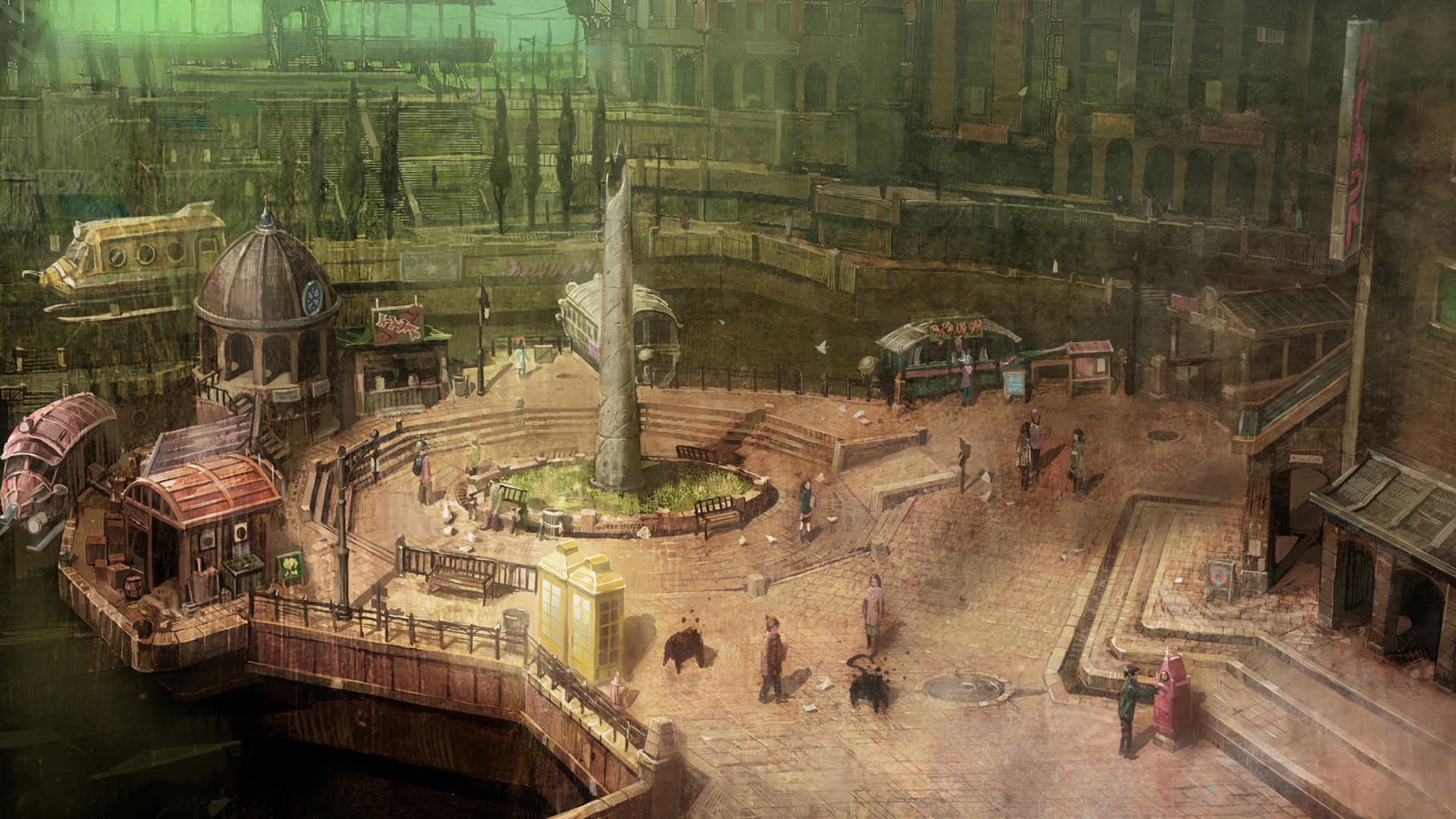
Auldnoir is named after a city from seminal, legendary, 7/7, perfect videogame series Gravity Rush. I picked it for three reasons:
When I made this place (two years ago now?? fucking HELL), I didn't think it'd go anywhere. I figured it'd peter out the same way as the last one did. But I could at least say I tried.
It turns out that it's probably my most successful project of any I've attempted in my strange little life. Certainly more successful than I could have imagined. Success enough that users on Auldnoir, independent of me, wanted to create this zine (which I am pronouncing as ‘zeen' in my brain to piss you off, specifically, Reader).
As of writing this piece, Auldnoir has 115k liked comments and 123 members. That's about 122 more users than I ever would have expected, and 115k more interactions than I expected. And I count every person who's joined Auldnoir as part of the community. I kind of have to since most of y'all lurk, but that's to be expected.
Before Auldnoir took off, and after the failure I mentioned above, I figured that making a forum in the 2020s was effectively impossible. Maybe the people who missed the old days were right, and they'd never return. But the fact of the matter is that it's more than possible. And the fact that it is gives me hope for the future of the internet, however small that hope may be.
Here's my secret tip to anyone wanting to get their own forum going. It's the magic bullet that will fix all of your anxieties. Unfortunately, it's magic that you simply can't control, because it involves the fickle, unpredictable nature of humanity. Creating Auldnoir wasn't half of the battle — it was one-tenth. The reality is that you need users that are willing to take a chance on a place. Users who will break out of prison of four websites that no one likes to post in a niche website named after a videogame they likely haven't played. Who will put their money where their mouths are and participate in a forum, rather than complain that forums are “dead.”
I'm lucky that so many people did more than just give Auldnoir a try. They stayed. And posted, and posted, and lurked, and posted, and posted some more. I'm lucky because I apparently have a strange, all consuming hunger to create community that makes people around me happy.2
At its base level, a forum is for posting. But to me, it's community. And what I've realized making this forum is that like gravity, I'm forever pulled towards creating a positive space for the people I care about.
To many more years. 🍹3
---
My submission is...this page. (Well. You know. Not the content on it.)
I did the HTML framing and scripting to make everything work. (Or work well enough, as the case may be.) Hopefully you enjoyed it.
Here's to another year, and another, and another.

See you next year!